Barbed Wire Fence Installation in Springfield, MO
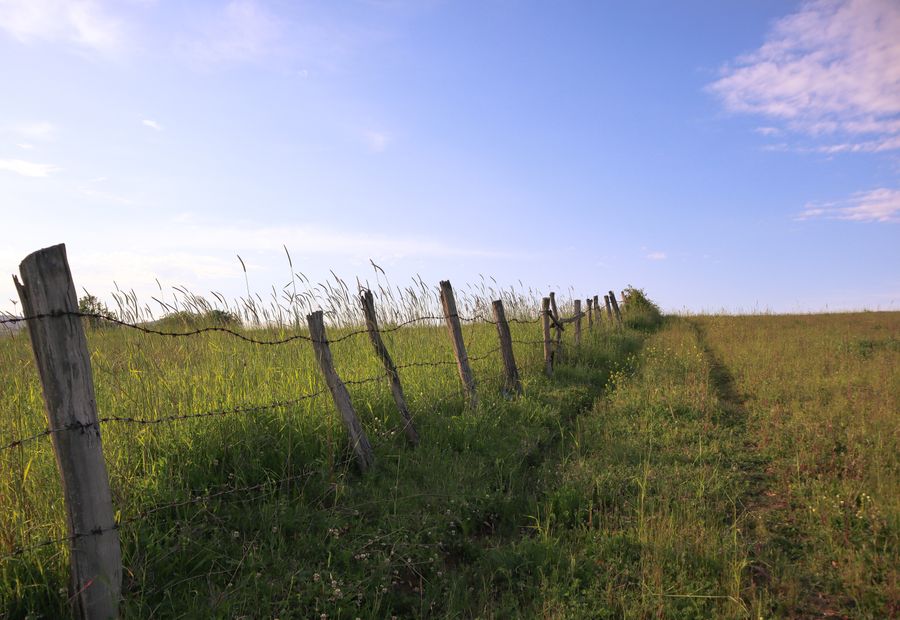
Springfield Farm Fence builds barbed wire fence for cattle operations, hay ground boundaries, and pasture divisions across Springfield, Willard, Fair Grove, Halltown, Marshfield, and Bolivar. Southwest Missouri is cow-calf country, and barbed wire is still the working fence on most of it. We install and repair barbed fence throughout Greene, Polk, Webster, Christian, Dallas, and Lawrence counties, Missouri.
Wire choice sets how long the fence stays tight. Red Brand barbed wire and Bekaert Gaucho high tensile both come in Class 3 coating, and that zinc is what stands between a strand and rust at every barb. We pull each strand with a wire stretcher off a braced wood end assembly, splice with a proper wrap or a crimped sleeve rather than a knot, and staple the line posts loose enough that wire can move with the weather. Corner posts are CCA ground contact treated, six to eight inches across, drilled into limestone to full depth. Steel T-posts fill the runs between at eight to twelve feet. What we build against is the fence everyone has patched before: three sagging strands wired to leaning T-posts with a rock pile at the corner.
Corners in Chert
A barbed fence lives or dies at the corner, and around Springfield the corner is where the rock is. A hand dug hole that stops at eighteen inches gives you a post that leans the first time all five strands come to tension. We drill those holes with a rock bit and set the post at full depth, then tie the corner back into the line with a full H-brace. Where bedrock is genuinely at the surface, the answer is a longer brace span or a drilled and grouted socket, never a shorter post with rock stacked around it.
Cattle Only, and Why That Matters
Barbed wire is a cattle fence. Horses cut themselves badly on it, and a horse that runs into barbed wire in a panic can end up with an injury that costs more than the fence did. Goats push their heads between strands and get hung. If cattle are the only stock on the place, barbed wire is the most fence per dollar you can buy. If horses share the ground, we will price you a board or woven fence instead and say why.
Repairs and Rebuilds
Plenty of our barbed work is bringing an old line back rather than starting over. We retension what is sound, replace rotted wood at the ground line where the failure always starts, and rebuild the corners that let the whole run go slack. Call (417) 612-8231. Rebuilds usually start with clearing the old line.
How many strands of barbed wire do you need for cattle?
Five is the common build for cow-calf pasture around here, standing about four and a half feet tall with the bottom strand roughly a foot off the ground. Spacing tightens toward the bottom because that is where calves try to go. Four strands will hold quiet cows on a small interior division. A boundary along a road, or a fence holding bulls, is a place to add a strand rather than save one.
What is the difference between two point and four point barbs?
The point count is how many barbs are twisted on at each cluster. Two point, sold as Defender by Red Brand, has a longer barb and slides through a stretcher more easily. Four point, sold as Ruthless, puts more points in contact and delivers a sharper message to an animal that leans. Cattle that push a fence get four point. Where people walk the line often, two point is the kinder choice.
Is high tensile barbed wire better than regular barbed wire?
It stays tight longer. Bekaert Gaucho high tensile barbed wire carries the same strength in a lighter, thinner strand, so a roll covers more ground and the wire resists stretching under a leaning cow. Soft barbed wire is easier to work by hand and forgiving on tight curves, but once it stretches it stays stretched. On a straight boundary run we go high tensile. On short doglegs and rough corners, soft wire earns its place.
Can T-posts hold a barbed wire fence?
They hold the wire up between corners, which is exactly their job. They do not hold wire back. Every strand pulls toward the end of the run, and a driven steel post has nothing resisting that pull, so corners, ends, gate openings, and any hard change in direction get wood posts and a brace assembly. A barbed fence built entirely on T-posts is a fence with no place for the load to go.