Board & Rail Horse Fence in Springfield, MO
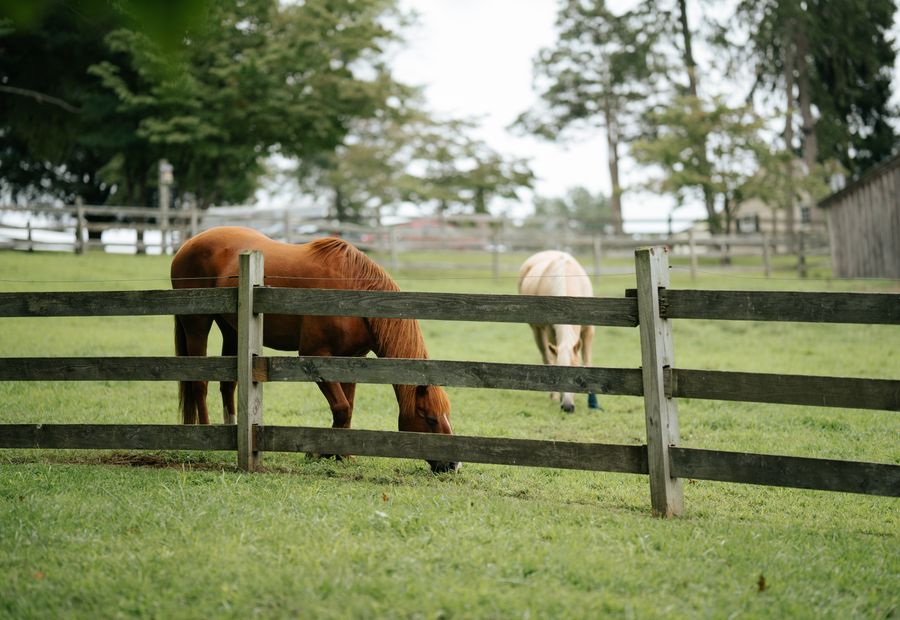
Springfield Farm Fence builds board and rail horse fence for paddocks, arenas, riding places, and ranch entrance frontage around Springfield, Rogersville, Republic, Ash Grove, and Fair Grove. Small horse farms sit thick on the acreages ringing Greene County, and we fence them across Greene, Christian, Webster, Polk, and Dallas counties, Missouri.
A board fence is a post fence with rails on it, so the posts decide everything. Ours are CCA ground contact treated, five to six inches across on the line and larger at corners and gates, set eight feet on center to match the board length. Every hole gets drilled to full depth even where limestone starts a foot down, because a rail fence telegraphs a leaning post to the eye from a hundred yards. Rails go on with ring shank nails or structural screws, splices land on post centers, and boards run on the inside face where horses push. Paint or a penetrating stain goes on after the wood has dried, not the week it was delivered. The comparison is a fence with posts sunk two feet into rocky ground and rails butted between them, which starts sagging in the first year and shows every inch of it.
Setting Posts in Ozark Rock
Board fence is the least forgiving fence type on shallow ground. A wire fence hides a short post. A rail line puts it on display. We drill through the chert layer with a rock bit, set the post to depth, and tamp backfill in lifts so the column packs back to the density it had before the auger. Where a post has to hold a gate or a corner, we pull the hole wider and brace it back into the fence line. On a slope the fence steps with the ground, with each panel racked so the rails stay parallel to the grade instead of stair-stepping.
Wood, Vinyl, and Hot Wire
Some clients want the look with less upkeep, and vinyl ranch rail delivers that on flat frontage near the house. It costs more up front and it does not take a hard hit the way oak does, so we generally put vinyl where the neighbors see it and wood where the horses live. Either way a hot wire along the top rail ends the cribbing and leaning that eats board fence faster than weather ever will.
Booking a Build
Board work runs spring through fall, and painting waits on dry weather either way. We quote through the winter and stage material so the crew starts when the ground turns. Call (417) 612-8231 to set a time to walk the paddock lines.
Three board or four board fence for horses?
Four board is the standard for a horse paddock and for any fence along a road. It puts a rail low enough that a foal cannot roll under and one high enough that a horse does not lean over. Three board costs less per foot and works well on interior divisions, on quiet stock, and where a hot wire runs on the top rail. Perimeter goes four board, interior can go three, and that split keeps a budget where it belongs.
Is oak or treated pine better for fence boards?
Rough sawn white oak is harder, heavier, and holds a nail through years of a horse leaning on it. It weathers gray if you leave it and it does not need treatment to last outdoors. Treated pine boards run straighter, take paint better, and cost less, but a horse can crack one. Many places around here use oak boards on treated posts, which puts the tough wood where the impact is and the treated wood where the rot is.
Why do horses need a visible fence?
A horse running from something does not look for wire. Smooth strands and even woven mesh are hard to see at speed, and a horse that hits a fence it did not see gets hurt and takes the fence with it. Boards give a solid visual line an animal reads from a distance and slows for. That visibility is most of what you are buying with a board fence.
Can you put wire mesh behind a board fence?
Yes, and for foals and mini horses it is worth doing. Two by four inch no-climb mesh goes on the inside face of the posts behind the boards, so a small hoof cannot get through the gap under the bottom rail. The boards carry the sight line and the impact, the mesh carries the containment. We staple the mesh to the posts before the boards go on, which hides the edge and keeps horses off the wire.