Farm Fence Installation in Springfield, MO
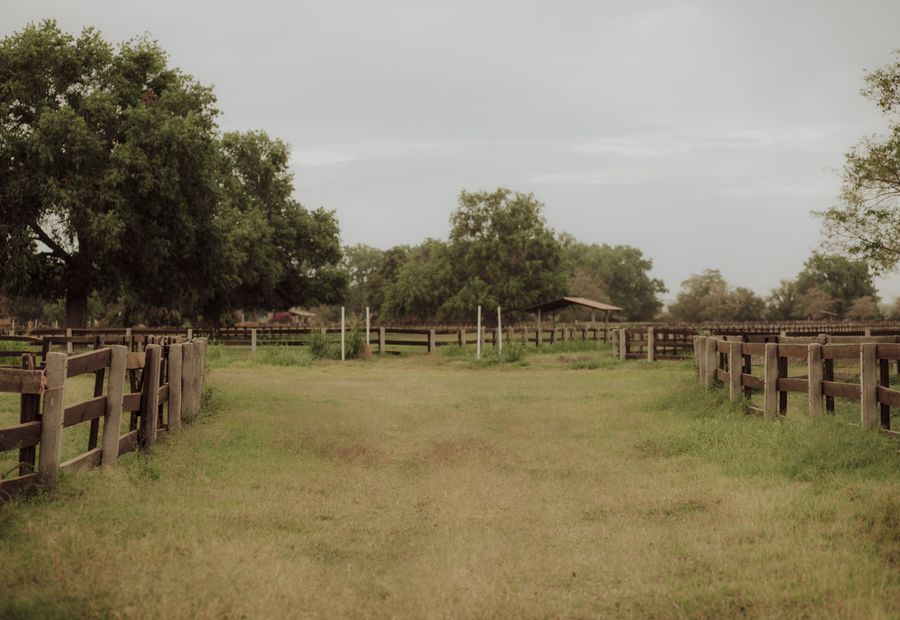
Springfield Farm Fence is a farm fence contractor building woven field fence, high tensile and electric fence, barbed wire, board fence, pipe corrals, and farm gates for cow-calf pastures, horse places, and small acreages around Springfield, Republic, Willard, Rogersville, Fair Grove, Ash Grove, Marshfield, Bolivar, and Halltown. Our crews work Greene, Christian, Webster, Polk, Dallas, and Lawrence counties, Missouri.
Wire pulls toward the end of every run, and the end assembly absorbs that load. So we brace every corner, end, and gate opening. Two posts carry the assembly. A horizontal rail joins them near the top. A brace wire runs twice around the diagonal and gets twisted until it rings. Brace posts measure six to eight inches across. Backfill goes in lifts and gets tamped hard, since packed soil grips the full column of the post, while concrete poured around treated wood traps water at the collar and rots it from the middle out. Wire carries Class 3 galvanizing, roughly three times the zinc that Class 1 puts on a strand. Woven fence goes up in Stay-Tuff fixed knot or Red Brand, posts are CCA ground contact treated pine, and the alternative most pastures already have is loose wire on driven T-posts with nothing bracing the corner.
Rock Instead of Dirt
Springfield sits on the Springfield Plateau, and under the pasture is cherty limestone. Dig a foot or two and the auger quits. A tractor auger with dirt teeth stalls and polishes rock. We drill those holes with a rock bit or break them with a hydraulic hammer, then set the post to full depth. Sinkholes turn up on this ground too, and a hole that keeps swallowing backfill needs a different post location rather than more gravel.
Braces Matter More on Shallow Ground
Where bedrock forces a post shallower than we would like, the brace carries what the depth cannot. That means longer H-brace spans, double H assemblies on tall multi-strand fences, and a drilled socket where a corner holds real tension. A brace built right lets a shallower post stand. A brace skipped is why a corner leans by the second summer.
What a Farm Fence Costs Around Here
Fence sells by the linear foot, and the fence type sets the band. Barbed wire builds cheapest. Woven field fence sits above it. High tensile lands near field fence once you add the energizer, the ground rods, and a strainer on every strand. Board costs several times a wire fence. Welded pipe costs the most per foot of anything we put up. Wire fence prices in single dollars a foot. Board and pipe price in tens of dollars a foot. The difference is lumber, steel, and welding time rather than wire.
Barbed wire and high tensile also price by the strand. Each strand you add is another spool, another pull, another tie-off at both ends, and another turn on the ratchet. A four strand fence and a six strand fence share the same holes and the same posts. They do not share the same wire bill or the same day count. We quote a strand plan and a post plan separately, so you can see which one you are paying for.
Four things move a quote here more than the wire choice does.
- Rock. A hole in soil takes a minute. A hole drilled into cherty limestone takes a rock bit, fuel, and machine time. We count the likely rock holes off the ground we can see, and we say where that count is a guess.
- Corners, ends, and gate openings. None of those is a post. Each is a full assembly: two heavy posts, a rail, brace wire, and the labor to build it square. A crooked boundary with eight bends costs more than a straight run twice its length.
- Terrain. Rolling ground pulls post spacing in, adds tie-down posts in the draws, and slows every material run up the line.
- Tear-out. Old wire, rotted posts, and a cedar-grown line all leave before a new post goes in. See fence line clearing and removal.
We do not price a farm fence over the phone. Acreage tells us almost nothing, because the same acres can be one square or a boundary with twenty angles. We walk the line, count assemblies, probe for rock, and price that layout.
Spacing, Tension, and Rolling Ground
Line posts for woven and barbed wire sit twelve to sixteen feet apart, closer on the slopes and anywhere cattle crowd. Driven steel T-posts sit closer, at eight to twelve feet. Their job is holding wire up, never holding it back. High tensile strands get pulled to a set tension with a ratchet strainer, with a spring on the line showing the number at a glance. Ozark ground rolls, so the fence follows the terrain instead of running level over it, with tie-down posts in the draws and floodgates where a line crosses a creek.
From Stakes to Cleanup
Layout comes first, and it happens with you standing there. We walk the run, find the survey pins if they exist, and stake every corner and gate opening before a single item gets ordered. A line that moves ten feet after the material lands is an expensive line. Once the stakes are in, we string the run and sight it from both ends. A fence you can sight down looks built. A fence that wanders reads as cheap from the road forever.
Clearing follows the stakes. Cedar, brush, and overhanging limbs come off a working width, so the machine can travel and so nothing drops on the wire in an ice storm. Corner and gate assemblies go in next, and they go in first on purpose. Every later step pulls against them. We drill each brace post to full depth, hammer through rock where the auger quits, backfill in lifts, and tamp each lift hard.
Line posts come next, set or driven to the spacing the fence type calls for and held to the string. Wire goes up last. Woven rolls get pulled from a braced end with a stretcher bar clamped across the full height. Barbed and smooth strands get pulled one at a time and brought to tension. Staples go in snug and not crushed, because wire has to slide a little through a staple as the seasons move it. Gates hang after the fence is tensioned. A gate hung into a slack line drags inside the first month.
Cleanup is part of the job. Old wire leaves the property in a roll. Post scraps, staples, wire ends, and cut cedar go with us. We walk the finished line with you before the trailer leaves. You should see a straight top line, wire in contact with the ground over the rises and through the draws, corners standing plumb, tie-downs in the low spots, and gates that swing and latch with one hand.
Horse Fence and Livestock Containment
The animal writes the spec. Cattle go against a fence, horses go over or through one, and goats go under it. A fence that holds one of them can fail badly for another.
Horse fence installation is its own build. A horse runs into what it cannot see, so visibility counts as much as strength. That means board, rail, or woven mesh with a top board or sight wire, and fifty four to sixty inches of height on breeding stock. Barbed wire is the wrong fence for horses, and we will say so before you buy it. A horse that hits barbs opens up, and the vet bill outruns the savings. Mesh for horse containment uses openings a hoof cannot enter, which is why a cattle roll belongs on a different line.
Cattle containment is a load problem instead of a visibility problem. Cows lean over a fence for the grass on the far side and roll the top down over a few seasons. Barbed strands, a heavier woven roll, or a hot wire on an offset bracket all answer that. Goats and sheep are a hole problem. They find the gap and push. Tight mesh low, the bottom wire pinned to the ground, and tie-downs in every dip keep them home. Bulls and stallions sit outside all of it and get pipe.
Lifespan, Upkeep, and Honest Limits
A fence built right on this ground is a twenty to thirty year asset. High tensile smooth wire with Class 3 coating on treated posts is the long one. Fixed knot woven field fence runs close behind it. Barbed wire on good posts holds for decades but ages at the barbs first, since that is where the coating wears. Board fence has the shortest life of the group. Boards weather, cup, and get kicked, and paint or stain is a recurring cost. Pipe outlasts everything else and only asks for paint where it rusts.
None of them is maintenance free. Wood posts rot at the ground line, where air and water meet, not at the tip. Check that spot with a boot every few years. High tensile loses tension by year three and gets it back with a few turns on the strainer, not a rebuild. Check the bottom of woven wire after a wet spring, because water through a draw lifts a roll and leaves a gap. Watch the hinge post on every gate, since a gate that starts to drag is a post that started to move.
Some fence types are wrong for some stock, and it is cheaper to hear it now. Hinge joint woven wire buckles and bags on steep ground, so rough pasture gets fixed knot. Electric alone is not enough on a highway boundary, a bull lot, or a crowded pen. Board fence looks right on a horse place and comes apart under cattle that lean on it. We build all of these, so we have no reason to sell you the wrong one.
Where the Fence Goes and Who Pays
Greene County runs under Missouri's general fence law, along with every county we serve. Under it the livestock owner carries the duty to fence his animals in. Where both neighbors run stock along the same boundary, each keeps up his half. A lawful fence stands at least four feet high on posts set firmly and no more than twelve feet apart. That is a legal floor, and the fences we build sit past it. Where the line itself is in question, get a survey first. Moving a built fence costs about what building it did.
Booking and Season
Building runs spring through fall. Frozen or saturated ground is a real reason a job waits, and we say so up front. Winter is when we walk lines and price work. Reach a real person at (417) 612-8231.
How much does it cost to put up a farm fence?
Farm fence prices by the linear foot, and the fence type sets the band. Barbed wire runs cheapest, woven field fence sits above it, high tensile lands near field fence once you count the energizer, and board and pipe cost the most per foot by a wide margin. Around Springfield three things move a quote more than the wire does: how much cedar and brush has to come off the line, how many holes hit rock, and how many corners, ends, and gate openings the layout calls for. Every corner is a full brace assembly, so a crooked boundary with eight bends costs more than a straight run twice as long. We walk the line with you and price the job in front of us.
What is the fence law in Missouri?
Most of Missouri runs under the general fence law, and Greene County is one of those counties. Under it the person who owns the livestock is responsible for fencing them in. Where both neighbors run stock along a boundary, each one keeps up his half. A small number of Missouri counties have voted themselves onto the local option law instead, and there both adjoining owners share a boundary fence whether or not either of them keeps animals. None of the counties we work sit on that list today, but county commissions can change it, so call your county clerk before you count on a neighbor paying half.
How high should a farm fence be?
Four feet is the floor Missouri sets for a lawful fence, and plenty of cattle fence gets built right at that. Height past the minimum follows the animal. Cattle hold behind forty eight inches of woven wire or five strands of barbed wire. Horses want fifty four to sixty inches so a spooked animal does not go over. Goats and sheep need the height plus tight mesh at the bottom, because they go through long before they go over. Bulls and stallions get their own spec, usually pipe.
How deep do fence posts go in Missouri?
Missouri sets no statewide minimum depth, so the number comes from the work rather than from a book. Our working rule is that a post sits as deep in the ground as the top wire stands above it. Line posts go two and a half to three feet, corner and brace posts three and a half to four. Around Springfield the limestone often stops you short of that, and then the answer is a rock bit and a deeper drilled hole, not a shorter post.